
Criminal Court Records in Coahoma County
Once charges are filed, the clerk opens a case file and gives it a number. That file is the criminal court record. It holds every document the court receives, every hearing it sets, and every order a judge enters. The Coahoma County Circuit Clerk keeps the criminal files for Circuit Court and County Court cases. Justice Court and Clarksdale Municipal Court keep their own records for the matters they hear. A file stays active while the case is open, and it remains on record after the case closes.
Mississippi splits criminal work across several courts. Circuit Court handles felony prosecutions in the Eleventh Circuit District, where a grand jury returns indictments. County Court and Justice Court hear misdemeanors and run the preliminary hearings that test felony charges. County Court can also take non-capital felony cases when Circuit Court transfers them. Clarksdale Municipal Court hears city misdemeanors and ordinance violations. The court that hears the case is the court that holds its record, so a single name can show files in more than one place.
Search Coahoma County Criminal Court Records
Coahoma criminal cases in Circuit, County, and Chancery Court are tracked through Mississippi Electronic Courts, the statewide case-management system known as MEC. Remote viewing needs a registered account and a user fee, so many people start at the clerk's counter or a public terminal. The steps below show the common path for an adult criminal case search.
- Open the Mississippi Electronic Courts portal and choose public access.
- Register through PAMEC for remote document viewing, or visit the Circuit Clerk counter to avoid the fee.
- Search by defendant name, or by case number when you know it.
- Narrow the results by court, case type, and filing date.
- Open the case to read the docket, the charges, and the disposition.
- Request a certified copy from the Circuit Clerk for any official use.
Not every Coahoma criminal record sits online. Justice Court and Municipal Court files often live only at their own counters. When a case is not in MEC, call or write the clerk with the defendant name, the case number if known, the case type, and an approximate date. The clerk can confirm whether a file exists and explain how to get copies.
Note: A booking or jail record is not the criminal court file, so the outcome of a case must be read from the clerk's docket, not the arrest log.
Stages of a Coahoma County Criminal Case
A criminal case moves through set stages, and each one leaves a mark in the record. The charge starts the file. The plea, the motions, and the trial fill it out. The disposition and the sentence close it. Reading a case in order makes the docket far easier to follow, since each entry maps to one of these steps.
Case flow: Charges Filed › Arraignment › Pretrial / Motions › Plea or Trial › Disposition › Sentencing
| Stage | What Happens |
|---|---|
| Charges Filed | An affidavit, citation, information, or grand-jury indictment opens the case and sets the charge level. |
| Arraignment | The defendant hears the formal charges and enters a plea of guilty, not guilty, or no contest. |
| Pretrial / Motions | Lawyers trade evidence, argue motions to suppress or dismiss, and weigh plea offers. |
| Plea or Trial | Most cases end in a plea; the rest go to a bench or jury trial that decides guilt. |
| Disposition | The case reaches an outcome: a plea, a verdict, a dismissal, or an acquittal. |
| Sentencing | After a guilty finding, the judge sets the sentence, fines, costs, and any probation terms. |
What a Coahoma County Criminal Record Shows
A criminal case file is built from many small fields. Some appear on the public docket, like the parties and the hearing dates. Others sit inside the full clerk file, such as motions, orders, and financial entries. The table below lists the fields a Coahoma criminal court record commonly carries and what each one tells a reader.
| Field | What It Shows |
|---|---|
| Case Number | The court's number for the case, used to pull the file in MEC or at the counter. |
| Court and Judge | Whether the case is in Circuit, County, Justice, or Municipal Court, and who presides. |
| Defendant | The person charged, named in the charging document and the docket entries. |
| Charges | The offenses filed, the statute cited, and whether each is a misdemeanor or a felony. |
| Plea | The defendant's formal response, such as guilty, not guilty, or no contest. |
| Disposition | The outcome of each charge: convicted, dismissed, acquitted, or otherwise resolved. |
| Sentence | The punishment imposed after conviction, with fines, costs, restitution, and probation. |
Older paper files may show less detail online than recent MEC cases. When a field looks blank, the clerk's physical file often holds the missing document. Certified copies carry the full, court-stamped version that courts and agencies accept.
Felony Prosecution in Coahoma County
Felony charges in Coahoma County are prosecuted by the District Attorney for the Eleventh Circuit Court District. Brenda F. Mitchell leads that office, which represents the State of Mississippi before the grand jury and at trial. The district covers Bolivar, Coahoma, Quitman, and Tunica Counties, with assistant district attorneys assigned to each. A felony record often shows a grand-jury indictment before any trial date appears.
The prosecutor decides which charges to pursue and may amend or drop counts as a case develops. The Eleventh Circuit District Attorney's office publishes its prosecution role and contact details on its official website.
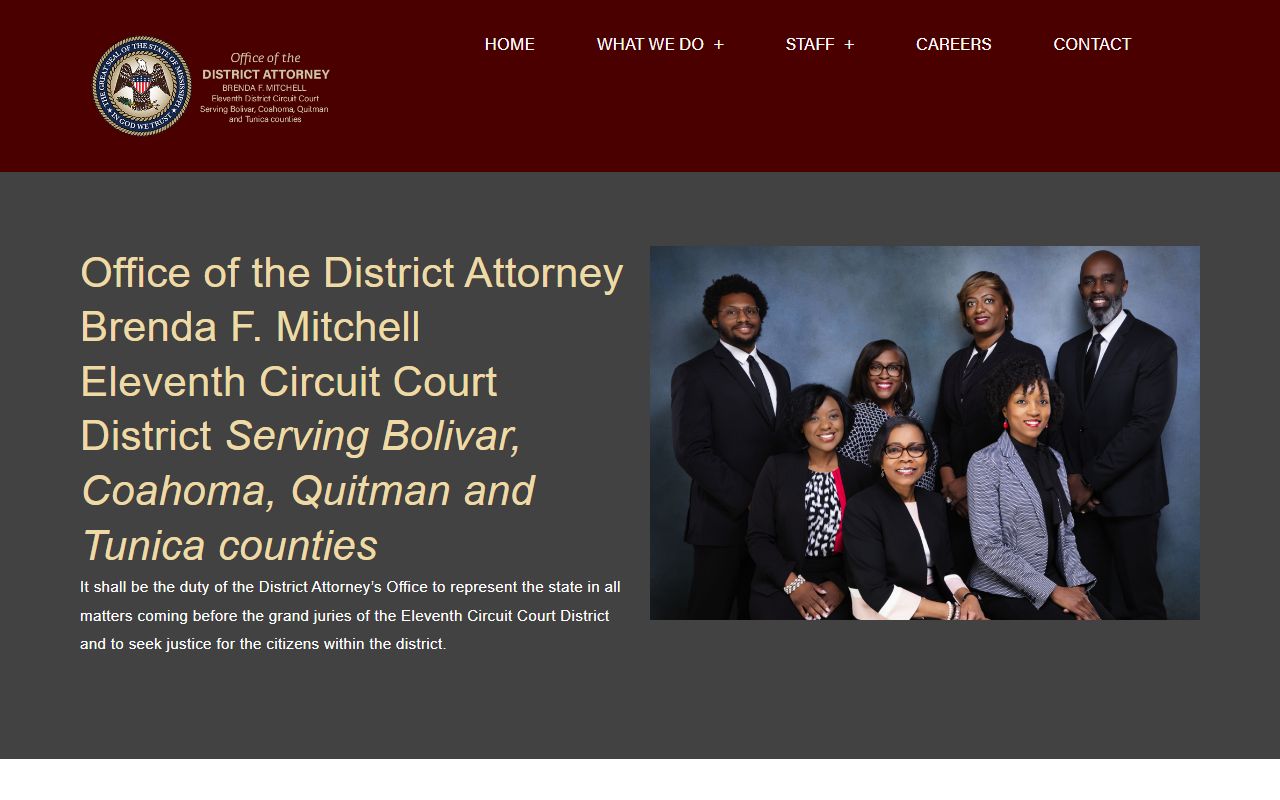
Reading that office helps explain why a felony file opens with an indictment and why the charges may shift between the first filing and the final judgment.
Charges vs. Convictions in Coahoma County
Being charged is not the same as being convicted. A criminal court record can list charges that were later dropped, dismissed, or ended in acquittal. A charge is only an accusation. A conviction is a finding or plea of guilt. Both can stay visible in the file, so a reader must check the disposition before drawing any conclusion.
| Charge | Conviction | |
|---|---|---|
| Stage | Accusation | Verdict or plea |
| Burden of Proof | Probable cause | Beyond reasonable doubt |
| Can Change | Amended, reduced, or dropped | May be appealed |
| Public Record | Yes | Yes |
Note: A record that lists a charge with no conviction does not show guilt, and the disposition line is the field that settles the question.
Reading Coahoma County Dispositions and Sentences
The disposition is the outcome of a charge, and it controls how the rest of the file reads. Common entries include guilty, not guilty, dismissed, no contest, and deferred. A guilty plea or verdict leads to a sentence. A dismissal or acquittal ends the charge without one. The sentence section then spells out jail or prison time, probation, fines, court costs, and restitution.
A defendant who cannot afford a lawyer may receive appointed counsel through the court that hears the case. Statewide support for indigent defense sits with the Mississippi Office of State Public Defender.
Whether a defendant had counsel and how they pleaded both appear in the docket, so the terms below help when reading those entries.
- Disposition
- The outcome of a charge or case.
- Plea
- The defendant's formal response, such as guilty or not guilty.
- Conviction
- A finding or plea that establishes guilt.
- Sentence
- The punishment imposed after a conviction.
- Probation
- Supervised release under conditions set by the court.
Sealed vs. Expunged Criminal Records
Some criminal records leave public view. A sealed record is closed from ordinary inspection by law or court order. An expunged record is treated as though it never existed, and the clerk should no longer share it with ordinary searchers. Mississippi allows expunction for qualifying records under Section 99-19-71, but eligibility turns on the offense, the waiting period, and a completed sentence.
| Sealed | Expunged | |
|---|---|---|
| Visibility | Hidden from public | Treated as never existed |
| Law Enforcement | Limited access | Very limited access |
| Eligibility | Youth Court and protected files closed by statute or order | First-offender misdemeanors and some felonies under Section 99-19-71 |
A Coahoma reader who wants to clear a record should start with the court that handled the case, then follow the petition path.
- Identify the court of conviction or dismissal: Justice, Municipal, County, or Circuit Court.
- Gather the case number, the disposition, the sentence-completion date, and proof that fines and costs are paid.
- Confirm eligibility under Section 99-19-71, since many violent, weapons, and sex offenses are excluded.
- File the petition with the correct clerk and pay any filing fee.
- Notify the prosecutor if local procedure requires it, and attend any hearing the judge sets.
- If granted, get certified copies of the order and ask which agencies receive it.
Criminal Records and Background Checks
A casual case lookup and a formal background check are not the same thing. Reading a docket for personal interest is one use. Screening a person for a job, a rental, or a loan is a regulated use under federal law. Court files can also lag behind the most recent court action, so a background decision should rest on certified records from the clerk, not a quick online glance.
Important: This resource is not a consumer reporting agency under the Fair Credit Reporting Act, and its records may not be used for credit, employment, tenant, or insurance screening.
Public Access to Criminal Court Records
Most criminal case files in Coahoma County are open under Mississippi law. The Public Records Act treats court records as available for inspection unless another law shields them. Adult charges, pleas, dispositions, and sentences are generally public, while youth files, sealed cases, and certain personal identifiers are not. The clerk that holds the file is the first place to ask for access.
Key Statutes:
Miss. Code Ann. § 25-61-1 - The Public Records Act makes public records open for inspection unless another law says otherwise.
Miss. Code Ann. § 25-61-5 - Gives a practical right to inspect and copy records under reasonable written procedures.
Miss. Code Ann. § 99-19-71 - Provides expunction paths for certain qualifying misdemeanor and felony records.
A reader who hits a closed door can file a written records request under the county's public-records policy. The full set of court files, including civil and family matters, sits in the broader Coahoma County court records the clerks maintain.
Federal Criminal Cases and Coahoma Records
Not every criminal case from Coahoma County belongs to the county courts. Federal crimes are prosecuted by the United States Attorney, not the Eleventh Circuit District Attorney. These cases route to the U.S. District Court for the Northern District of Mississippi, and their files are searched through PACER rather than the Circuit Clerk.
The U.S. Attorney for the Northern District of Mississippi describes the federal prosecutor's role for this region.
Keeping the two systems apart matters, because a federal case will never show up in the county clerk's criminal docket.
Restricted Criminal Court Records in Coahoma County
Some criminal-related files are closed even though most adult cases are open. Youth Court records are confidential under Section 43-21-251, and they may be shared only with authorized people or by court order under Section 43-21-261. A juvenile case is not searched like an adult docket, so a public criminal portal will not return it.
Sealed and expunged cases also drop out of public view, and certain judicial work papers are exempt under Section 9-1-38. Even in an open file, the clerk may redact Social Security numbers, financial account details, minor names, and protected addresses. The arrest side of a case, with booking detail, sits in the county arrest and charge records instead.
Note: The fact that a case exists does not mean every attachment is public, since the court can withhold sensitive documents while still listing the case on the docket.